Dr. Kennedy
The GodfatherDr. Kennedy is a recurring physician whose brief appearances reveal how professional medicine operates alongside, and sometimes becomes dependent on, the Corleone Family’s private network of obligation. He represents institutional authority, but the narrative repeatedly places that authority in situations where Don Vito Corleone’s personal power, friendship, and debts determine what happens next.
Identity and Introduction
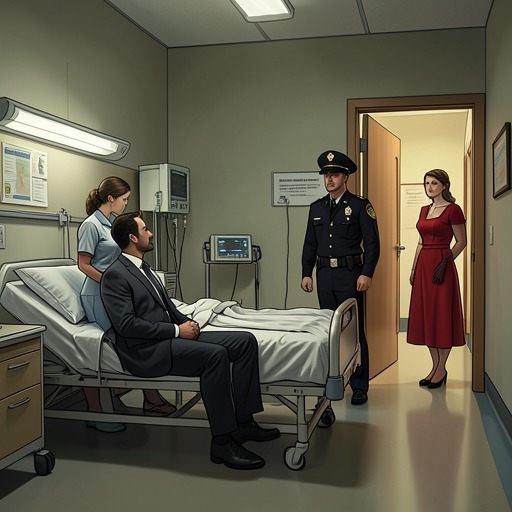
Dr. Kennedy is introduced at the hospital where Genco Abbandando is dying during Constanzia Corleone’s wedding day. A young, serious-faced doctor with the bearing of a man accustomed to command, he initially limits the visitors to the immediate family because Genco is in torturous pain and should be allowed to die in peace. His judgment is medically defensible, but the family does not treat him as the final authority. When the relatives turn toward Don Vito Corleone for a decision, Dr. Kennedy sees that the short, heavy man in the ill-fitting tuxedo commands a different kind of obedience.
Don Vito Corleone asks whether Genco is dying. Once Dr. Kennedy confirms it, the Don tells him that there is nothing more for the doctor to do: the family will assume the burden, comfort Genco, close his eyes, bury him, mourn him, and look after his wife and daughters. The statement forces Mrs. Abbandando to understand that her husband is about to die. Dr. Kennedy withdraws politely, acknowledging the crude justice of the Don’s claim even while regarding the grieving family as unable to understand the situation properly. His first scene therefore establishes a contrast between medical knowledge and familial responsibility: medicine diagnoses the approaching death, while the Corleone Family claims the duties that surround it.
Professional Authority and Corleone Protection
Dr. Kennedy later becomes part of the practical machinery protecting Don Vito Corleone after the attempted assassination that leaves the Don hospitalized. Tom Hagen’s security plan combines private detectives with the soldiers of the Tessio organization. When the Don can safely be moved, his room at the Long Beach mall is converted into a fully equipped hospital suite, nurses are hired for round-the-clock care, and Dr. Kennedy is persuaded, for a huge fee, to become the physician in residence until the Don requires only nursing care.
The arrangement changes the meaning of his medical role. Dr. Kennedy is no longer simply an independent doctor governing access to a dying patient; he becomes a professional retained inside a private stronghold whose tenants and guards have been reorganized for security. The home hospital makes medicine part of the Family’s defensive infrastructure. His expertise remains necessary, but its deployment is controlled by the Don’s resources and by the Family’s capacity to turn a residence into an institution.
This episode also clarifies the broader system in which Dr. Kennedy is caught. Don Vito Corleone’s influence rests on favors granted without immediate payment, with friendship and respect creating debts that may later be redeemed through service. The Family’s organization formalizes that influence through counselors, caporegimes, soldiers, and layers of insulation between orders and operations. Dr. Kennedy’s position shows the same principle in a less openly violent form: professional assistance is secured through money, personal ties, and an obligation established by the Family’s reputation.
Connection to Jules Segal
Dr. Kennedy’s most important offstage connection is with Jules Segal. When Jules explains his presence in Las Vegas to Lucy Mancini, he identifies himself as a surgeon who was blacklisted after being caught performing abortions. His friend Dr. Kennedy, with whom he had interned, agreed to help him. Dr. Kennedy had learned from Tom Hagen that the Corleone Family was indebted to him if he ever needed assistance, and he therefore approached Hagen. The result was that the charges against Jules were dropped and the Corleone Family obtained work for him in Las Vegas.
This account gives Dr. Kennedy a decisive role in converting a private professional relationship into institutional protection. He does not personally employ Jules or openly challenge the medical establishment; instead, he activates a debt within the Corleone network. The episode places him at the intersection of medicine, law, professional exclusion, and organized power. His knowledge and standing enable him to call upon the Family, while the Family’s influence supplies the remedy that formal institutions refuse to provide.
Jules’s description also makes clear that Dr. Kennedy is regarded as a morally serious and dependable man. Jules calls him a straight person, and his willingness to help contrasts with the Medical Association and Eastern establishment that have blacklisted Jules. Dr. Kennedy’s conduct suggests that his relationship with the Corleone Family is not presented merely as a commercial transaction. He has become one of the people whose earlier assistance creates a debt that the Don’s system is prepared to honor.
Narrative Function and Significance
Dr. Kennedy is not a central strategist or combatant, and the narrative gives him no independent plot arc or final resolution. His importance lies in the institutional worlds he connects. At Genco Abbandando’s bedside, he embodies the formal authority of the hospital, yet Don Vito Corleone’s familial command overrides the practical limit he tries to impose. In the Long Beach home hospital, he becomes a component of the Family’s private security and care system. In Jules Segal’s story, he is the trusted professional whose claim on the Family’s gratitude opens a path through legal and medical exclusion.
These appearances make Dr. Kennedy a measure of the Corleone Family’s reach. The Family does not simply threaten opponents; it recruits doctors, protects patients, settles obligations, and supplies alternatives when courts or professional bodies close their doors. Dr. Kennedy’s presence also exposes the ambiguity of that reach. His medical authority is real, but it is repeatedly absorbed into a hierarchy governed by personal loyalty, money, and reciprocal debt. Through him, the narrative shows how the Family’s private government can coexist with official institutions while quietly redirecting their services and decisions.